Wednesday, August 13, 2008

"The Sonic Boom Salesman" Flies Again!


One of the greatest thrills I’ve had so far in the 21st century was the day I blasted off the runway at Andrews Air Force Base, Maryland in an F-16 Viper along with the pilot-in-command, Brigadier General David Wherley.

The flight included a supersonic run twenty-five miles off the Maryland coast with speed building to Mach 1.5, one and a half times the speed of sound (1000 + MPH). Aerobatics followed that with aileron rolls, barrel rolls and a loop. The flight was topped off with a high performance vertical climb.

It was quite a ride and given as an orientation for the two half-day programs I presented for the Washington, DC Air National Guard the day prior. The morning program was Leadership When the Heat's On for officers and non-commissioned officers. Then in the afternoon I presented to the recruiters my There Are No Limits program.

Breaking the sound barrier was not new for me. I have broken the barrier almost 2000 times in various high performance fighters I flew in the Air Force, which included the 1200-MPH "Voodoo." In lay terms that's twenty miles per minute or one mile every three seconds!

At those speeds you can break plenty of windows and knock off great chunks of plaster. That's how I picked up the nickname, "The Sonic Boom Salesman." I went out to the communities hard hit by these "booms" and spoke to the hostile, upset civilian audiences. My speech title back in those years was "Better Boomed than Bombed"––a hard hitting speech!

And, yes, I can handle any audience you put in front of me.

Thursday, August 7, 2008

Butt Snappers

After speaking ten years of my life flying supersonic at twice the speed of sound a major problem was solved by the Air Force. To this day I think it has some real cross over value to the business world.

As jet fighters were being introduced to the Air Force, a problem arose with ejection seats. Jets flew faster and higher than their propeller predecessors and pilot ejection, in cases of emergency, became a more sophisticated and dangerous predicament. Ejection seats were separated from the cockpit by an explosive charge equal to a 35mm artillery shell to insure that the pilot cleared the aircraft before the parachute deployed.

The pilot simply needed to roll forward out of the seat once clear of the aircraft and the parachute would be free to open. parachute would be free to open. Unfortunately, a common problem started to pop up (no pun intended) in some ejections. Some pilots would pull up both arm rests exposing the ejection seat triggers and squeeze them detonating the explosive that launched the pilot and seat 150 to 175 feet above the aircraft.

Then, instead of letting go, some pilots kept a death grip on the seat handles, reluctant to separate themselves from the last tangible piece of the airplane that had, until then, always been a safe place. As long as the pilot remained in the ejection seat, the parachute remained trapped against the seat back, unable to open. Striking the ground at 200 miles per hour, still sitting in an ejection seat with an unopened parachute will ruin your whole day!

The Air Force went back to the ejection seat manufacturers with the problem and the government contractors returned with a solution. The new design called for a 2-inch webbed strap that attached to the front edge of the seat, under the pilot and behind him, and attached to an electronic take-up reel behind the headrest. Two seconds after ejection, the electronic take-up reel would immediately take up the slack, forcing the pilot forward out of the seat thus freeing the parachute to open. The pilot was “butt-snapped “ to safety.

A body in motion tends to remain in motion and a body at rest tends to remain at rest until acted upon by an external force. Dr. Alexis Carrel used this definition of inertia in a sentence:

Life leaps like a geyser for those who drill through the rock of inertia.

In a seminar, I once quoted Dr. Carrel and gave a lengthy dissertation on the role of external forces to overcoming inertia. After I had finished, one of those in attendance came up to me and winked.

“I know what you’re trying to say about overcoming inertia,” the man said. “What you mean to say is that we need butt snappers on every chair around the office.”

A butt-snapper, as he described it, is something akin to a spring-loaded whoopee cushion. The bottom line is that, when detonated, it launches your rear end out of the chair. So, if words like external forces overcoming inertia leave you uninspired, think about what butt snappers on everyone’s chairs would do to productivity around the office. Think about how much a butt snapper on your own chair would do for your personal productivity.


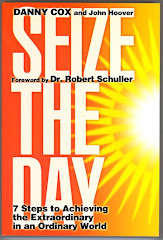
Excerpted from Danny Cox's book, Seize the Day: 7 Steps to Achieving the Extraordinary in an Ordinary World.

Tuesday, July 29, 2008

The Road Block to Higher Productivity: Fear vs. Courage

"Once when Marshall Ney was going into battle, looking down at his knees which were smiting together, he said, 'You may well shake; you would shake worse yet if you knew where I am going to take you."
-- Orison Swett Marden

What or who builds self-imposed barriers? A stonemason named Fear, one who is highly skilled in building powerful barriers from nonexistent stones. Where does this craftsman live? In our minds. He's always there, but it's up to us whether he lives in the back of our minds or the front of our minds.

Fear is the sworn enemy of adventure, which is perhaps the most exhilarating force driving no-limits achievement. And Fear goes exactly where we tell him to go.

We move Fear from the back of our minds to the front of our minds by shifting our concentration away from our own courage, and choosing instead to focus on that which frightens us. Not only does that action change Fear's location, but through the process of concentration, it means we actually start to strengthen Fear. Fear has no strength of its own; its only strength is that which we choose to give it.

When Fear defeats us, it does so because of our own mental focus. And unfortunately, the strength we pass along to Fear is the very strength we need to overcome it! If, on the other hand, we choose to push our goals, wrapped in courage, to the forefront of our minds, then barriers break.

You already possess sufficient courage to initiate this process and see your personal adventure through. A person may not be born with an overabundance of talent, but he or she will certainly possess all the courage needed, whether used or unused, to develop the talent that is there. Long after passing on to the next world, we will be remembered by family and friends, not necessarily for our inborn talents, but for the amount of courage we used, especially during our times of trial. The strength and vividness of the memories our loved ones and friends hold of us after we are gone will be directly proportional to the amount of courage we have chosen to use.

Immediate Action: Starve your fear! Feed your courage! Embrace your adventure!

Point to Ponder: "Fear knocked at the door. Faith answered. No one was there." (From above the fireplace at Hinds' Head Hotel, near London.)


"We're tied with straw and think it's chain."
Danny Cox

Excerpted from Danny Cox’s book, There Are No Limits: Breaking the Barriers to Personal High Performance.

Visit this Blog often as new articles are being posted for managers and sales people/employees.


Tuesday, April 1, 2008

Danny Cox, The Accelerationist

My clients refer to me as “The Accelerationist”, 1: one who causes faster movement, higher efficiency and increased productivity, 2: one who boldly crosses barriers, 3: an adventurer at high speed

In future Blogs I will Post other articles from my three best selling books, Leadership When the Heat’s On Second Edition: Building A record Breaking Team, Seize The Day: Seven Steps To Achieving The Extraordinary In an Ordinary World and There Are No Limits: Breaking The Barriers In Personal High Performance.

This Post features my most popular article from Leadership When The Heat's On. You can find more information about my Keynotes and Seminars and also my books on my website at http://www.dannycox.com.

Ten Leadership Characteristics
By
Danny Cox

No organization can rise above the quality of its leadership. Because leadership is a position that must be earned day in and day out, there are important personal choices that both new and experienced leaders must make on a regular basis. Effective leaders are first and foremost effective people.

Personal ethics can't be separated from professional ethics. Therefore, the character of the leader is essential. The following list of ten characteristics is a valuable guide for quality living in addition to being critical criteria for leadership.

1. A high standard of personal ethics leads the list. Honest Abe Lincoln, who walked miles to return a customer's change, is a classic example of how personal ethics are reflected in professional conduct. Decisions made under pressure and/or temptation separate the great ones from the impostors.

2. High energy. Dealing with petty issues does not exhaust great leaders. These people know right from wrong as well as the difference between what's truly important and what's merely interesting.

3. The ability to work priorities shares equal importance with setting priorities. Many brilliant priority lists end up in the landfill of life. The difference between setting priorities and working them through is the difference between a dreamer and a doer.

4. Courage. The willingness to take risks and accept responsibility for the outcome is a consistent quality among effective leaders. Either you or your fears will control everything you do. An organization will be no bolder than the leader.

5. Committed and dedicated hard working leaders will eventually develop dedicated and hard working organizations regardless of who they start with or the experience they bring to the job.

6. Unorthodox leaders have an urge to create and don't have the patience to wait for a phone to ring before acting. Effective leaders are innovators who bore easily and prefer shaping tomorrow to repeating yesterday.

7. Great leaders have the goal orientation to make tough decisions. Goal orientation produces a drive and energy that shield us from the pain of the task. Keeping an organization focused increases efficiency.

8. Inspired enthusiasm is like the pilot light on the oven. Genuine enthusiasm is contagious. People look to their leaders for enthusiasm. The inspiration level of the organization is directly proportionate to the enthusiasm of the leader--be it high or low.

9. Level-headed people make realistic leaders who respond to problems rather than simply react. A leader who can stay cool under pressure inspires confidence among those in the organization and empowers them to do the same.

10. The desire to help others succeed is the mark of a truly great leader. Synergy is created when a leader truly invests his or her efforts in the success of others. Zig Ziglar says it like this, "People don't care how much you know until they know how much you care about them."

Whether you're trying to increase your own effectiveness as a leader or are trying to develop leadership talent within your organization, keep studying the characteristics of those you consider to be great leaders.

Remember that leadership is an art, not a science and the difference between a genuinely effective leader and a short-term motivator can be found in the personal decisions an individual makes when choosing how to live his or her life. Long-term commitment to the principles described above will produce an effective leader and, over time, an inspired organization.

Excerpted from Leadership When The Heat's On 2nd Edition
By Danny Cox (McGraw-Hill).